
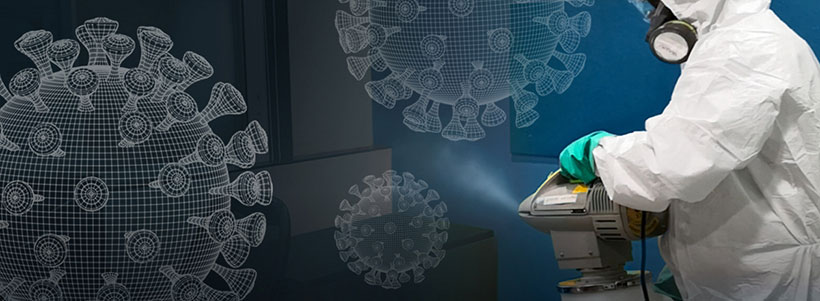
An infectious outbreak in your place of living or business is not only dangerous to the health of you, your family or your employees and clients; it can also hurt your company’s reputation beyond repair, cause you to lose profits and customers, and so much more. In short, an infectious outbreak can be the end of your life or business. Disinfection services kill pathogen bacteria, viruses, and more to help you keep the health of your place intact. Every industry is at risk for the spread of contamination, and we’ll work with you to put a prevention plan in place to keep your business protected.
We are expert in disinfecting places of Novel coronavirus (COVID-19), we have our (DCP) Disinfection Comprehensive Program which is effective to eliminate 99.9% of Pathogens, you will find below all updated information regarding Novel coronavirus:
Introduction and background
In late 2019, an acute respiratory disease emerged, known as novel coronavirus disease 2019(COVID-19). The pathogen responsible for COVID-19 is severe acute respiratory syndrome coronavirus 2 (SARS-CoV-2, also referred to as the COVID-19 virus), a member of the coronavirus family. In response to the growing spread of COVID-19.
Symptoms of Coronavirus
Reported illnesses have ranged from mild symptoms to severe illness and death for confirmed coronavirus disease 2019 (COVID-19) cases.
These symptoms may appear 2-14 days after exposure (based on the incubation period of MERS-CoV viruses:
- Fever.
- Cough.
- Shortness of breath.
When to Seek Medical Attention
If you develop emergency warning signs for COVID-19 get medical attention immediately. Emergency warning signs include:
- Trouble breathing.
- Persistent pain or pressure in the chest.
- New confusion or inability to arouse.
- Bluish lips or face.
This list is not all inclusive. Please consult your medical provider for any other symptoms that are severe or concerning.
How COVID-19 Spreads
COVID-19 is a new disease and we are still learning about how it spreads and the severity of illness it causes.
Person-to-person spread
The virus is thought to spread mainly from person-to-person.
- Between people who are in close contact with one another (within about 6 feet).
- Through respiratory droplets produced when an infected person coughs, sneezes or talks.
- These droplets can land in the mouths or noses of people who are nearby or possibly be inhaled into the lungs.
- Some recent studies have suggested that COVID-19 may be spread by people who are not showing symptoms.
Spread from contact with contaminated surfaces or objects
It is possible that a person can get COVID-19 by touching a surface or object that has the virus on it and then touching their own mouth, nose, or possibly their eyes.
How easily the virus spreads
How easily a virus spreads from person-to-person can vary. Some viruses are highly contagious, like measles, while other viruses do not spread as easily. Another factor is whether the spread is sustained, which means it goes from person-to-person without stopping.
- The virus that causes COVID-19 is spreading very easily and sustainably between people.
- Information from the ongoing COVID-19 pandemic suggest that this virus is spreading more efficiently than influenza, but not as efficiently as measles, which is highly contagious.
- The Virus can live on surfaces for long periods depending on the surface type, e.g. on metal could be 72 hours.
How to Protect Yourself & Others
- Clean your hands often.
- Avoid close contact
- Wear PPE (Personal Protection Equipment)
- Clean and disinfect
Hand Washing is a critical factor in the fight
Handwashing is one of the best ways to protect yourself and your family from getting sick. Learn when and how you should wash your hands to stay healthy.
Washing hands can keep you healthy and prevent the spread of respiratory and diarrheal infections from one person to the next. Germs can spread from other people or surfaces when you:
- Touch your eyes, nose, and mouth with unwashed hands.
- Prepare or eat food and drinks with unwashed hands.
- Touch a contaminated surface or objects.
- Blow your nose, cough, or sneeze into hands and then touch other people’s hands or common objects.
Key Times to Wash Hands
You can help yourself and your loved ones stay healthy by washing your hands often, especially during these key times when you are likely to get and spread germs:
- Before, during, and after preparing food.
- Before eating food.
- Before and after caring for someone at home who is sick with vomiting or diarrhea.
- Before and after treating a cut or wound.
- After using the toilet.
- After changing diapers or cleaning up a child who has used the toilet.
- After blowing your nose, coughing, or sneezing.
- After touching an animal, animal feed, or animal waste.
- After handling pet food or pet treats.
- After touching garbage.
During the COVID-19 pandemic, you should also clean hands:
- After you have been in a public place and touched an item or surface that may be frequently touched by other people, such as door handles, tables, gas pumps, shopping carts, or electronic cashier registers/screens, coppiers, switches, Elevator Buttons, etc.
- Before touching your eyes, nose, or mouth because that’s how germs enter our bodies.
Follow Five Steps to Wash Your Hands the Right Way:
Washing your hands is easy, and it’s one of the most effective ways to prevent the spread of germs. Clean hands can stop germs from spreading from one person to another and throughout an entire community from your home and workplace to childcare facilities and hospitals. Follow these five steps every time:
- Wet your hands with clean, running water (warm or cold), turn off the tap, and apply soap.
- Lather your hands by rubbing them together with the soap. Lather the backs of your hands, between your fingers, and under your nails.
- Scrub your hands for at least 20 seconds.
- Rinse your hands well under clean, running water.
- Dry your hands using a clean towel or air dry them.
Use Hand Sanitizer When You Can’t Use Soap and Water
You can use an alcohol-based hand sanitizer that contains at least 60% alcohol if soap and water are not available.
Washing hands with soap and water is the best way to get rid of germs in most situations. If soap and water are not readily available, you can use an alcohol-based hand sanitizer that contains at least 60% alcohol. You can tell if the sanitizer contains at least 60% alcohol by looking at the product label.
Sanitizers can quickly reduce the number of germs on hands in many situations. However,
- Sanitizers do not get rid of all types of germs.
- Hand sanitizers may not be as effective when hands are visibly dirty or greasy.
- Hand sanitizers might not remove harmful chemicals from hands like pesticides and heavy metals.
Caution! Swallowing alcohol-based hand sanitizers can cause alcohol poisoning if more than a couple of mouthfuls are swallowed. Keep it out of reach of young children and supervise their use.
How to use hand sanitizer:
- Apply the gel product to the palm of one hand (read the label to learn the correct amount).
- Rub your hands together.
- Rub the gel over all the surfaces of your hands and fingers until your hands are dry. This should take around 20 seconds.
Avoid close contact:
- Avoid close contact with people who are sick.
- Stay home as much as possible.
- Put distance between yourself and other people.
- Remember that some people without symptoms may be able to spread virus.
- Keeping distance from others is especially important for people who are at higher risk of getting very sick.
Wear PPE (Personal Protection Equipment)
Use Face Mask or Cloth Face Covering:
You could spread COVID-19 to others even if you do not feel sick.
Everyone should wear a Mask or cloth face cover when they have to go out in public, for example to the grocery store or to pick up other necessities.
Masks or Cloth face coverings should not be placed on young children under age 2, anyone who has trouble breathing, or is unconscious, incapacitated or otherwise unable to remove the mask without assistance.
The cloth face cover is meant to protect other people in case you are infected.
Continue to keep about 6 feet between yourself and others. The cloth face cover is not a substitute for social distancing.
Use Hand Gloves
- Use hand gloves when in contact with sick person.
- Use hand gloves when cleaning or disinfecting.
- Use hand gloves when touching contaminated surfaces.
- Don’t touch your nose, mouth or eyes when you are wearing hand gloves.
- Wash your hands with soap before and after wearing your hand gloves.
- Disinfect all of your used personal things such as phone, keys, wallet etc... after removing hand gloves.
Clean and disinfect:
Clean
Clean surfaces using soap and water. Practice routine cleaning of frequently touched surfaces.
High touch surfaces include: Tables, doorknobs, light switches, countertops, handles, desks, phones, keyboards, toilets, faucets, sinks, elevator buttons etc.
Disinfect
Hard Surfaces:
- Clean the area or item with soap and water or another detergent if it is dirty. Then, use disinfectant.
- Recommend use of EPA-registered household disinfectant external icon. Follow the instructions on the label to ensure safe and effective use of the product.
- Many products recommend:
- Keeping surface wet for a period of time (see product label)
- Precautions such as wearing gloves, masks and goggles and making sure you have good ventilation during use of the product.
Soft Surfaces:
For soft surfaces such as carpeted floor, rugs, and drapes:
- Clean the surface using appropriate Cleaners like the ones EPA-registered for use on these surfaces against COVID-19.
- Launder items (if possible) according to the manufacturer’s instructions. Use the warmest appropriate water setting and dry items completely.
Electronics:
For electronics, such as tablets, touch screens, keyboards, remote controls, and ATM machines:
- Consider putting a wipeable cover on electronics.
- Follow manufacturer’s instruction for cleaning and disinfecting.
- If no guidance, use alcohol-based wipes or sprays containing at least 70% alcohol. Dry surface thoroughly.
Laundry:
For clothing, towels, linens and other items:
- Launder items according to instructions. Use the warmest appropriate water setting and dry items completely.
- Wear disposable gloves when handling dirty laundry from a person who is sick.
- Dirty laundry from a person who is sick cannot be washed with others laundry.
- Do not shake dirty laundry.
- Clean and disinfect clothes hampers according to guidance above for surfaces.
- Remove gloves, and wash hands right away.
Cleaning and disinfecting your building or facility if someone is sick:
- Close off areas used by the person who is sick.
- Open outside doors and windows to increase air circulation in the area. Wait 24 hours before you clean or disinfect. If 24 hours is not feasible, wait as long as possible.
- Clean and disinfect all areas used by the person who is sick, such as offices, bathrooms, common areas, shared electronic equipment like tablets, touch screens, keyboards, remote controls, and ATM machines.
- If more than 14 days since the person who is sick visited or used the facility, additional cleaning and disinfection is not necessary.
- Continue routing cleaning and disinfection.
When Cleaning:
- Wear disposable gloves and gowns for all tasks in the cleaning process, including handling trash.
- Additional personal protective equipment (PPE) might be required based on the cleaning/disinfectant products being used and whether there is a risk of splash.
- Gloves and gowns should be removed carefully to avoid contamination of the wearer and the surrounding area.
Wash your hands often with soap and water for 20 seconds.
- Always wash immediately after removing gloves and after contact with a person who is sick.
- Hand sanitizer: If soap and water are not available and hands are not visibly dirty, an alcohol-based hand sanitizer that contains at least 60% alcohol may be used. However, if hands are visibly dirty, always wash hands with soap and water.